
This is an original story by Mongabay and is republished through the Indigenous News Alliance.
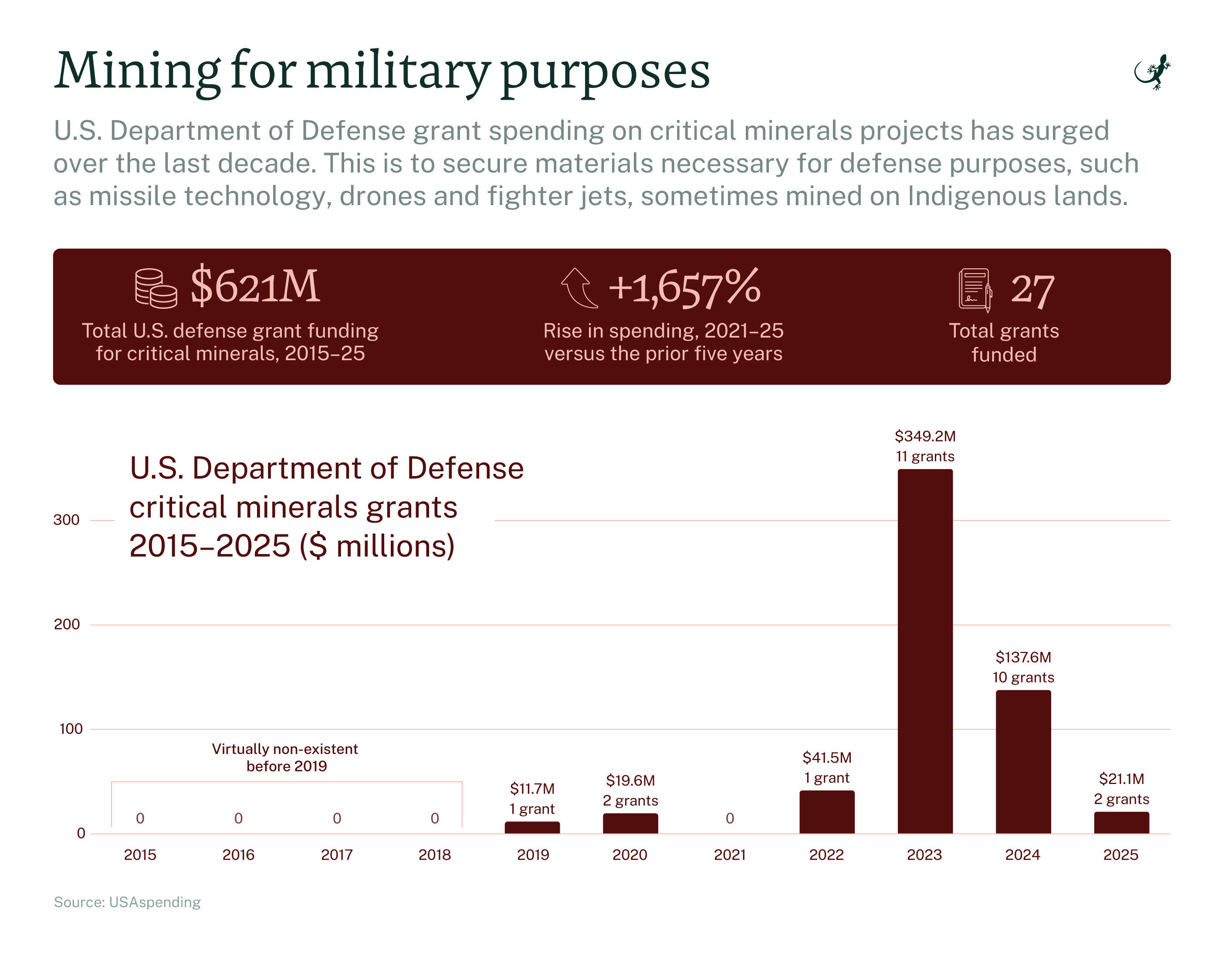
Over the past decade, Department of Defense spending for critical minerals transformed from virtually nonexistent into a major spending area. The last five years in particular have seen a dramatic surge in both contracts and dollar value.
Although minerals like lithium and nickel can be used for renewable energy and green technology like electric vehicle batteries, they are also key components for military equipment and weapons. Indigenous leaders have been demanding corporations and countries respect their right to consent to mining projects on their land, regardless of the intended use of those minerals. As global demand for these minerals continues to rise, Indigenous communities say that state backing has fast-tracked approvals without essential environmental safeguards or meaningful consultation by companies.
Mongabay aggregated information from the USAspending database — an official open data source of federal spending information — about Department of Defense grant spending on critical mineral projects for military purposes between 2015 and 2025.
This figure does not include Pentagon spending on military contractors, which is a major way that the Department of Defense spends its money. The actual amount is likely larger given that some projects may not be public due to national security reasons, according to the Congressional Research Service.
Mongabay decided to focus only on grants, as other types of contracts are generally non-binding and do not guarantee federal spending.
It found that the federal agency provided an estimated $621 million in grants for critical mineral projects for defense purposes over the period, according to the USAspending database. Between 2021 and 2025, the Pentagon secured 24 agreements worth nearly $550 million — up from just $31.3 million for three contracts in the previous five-year period.
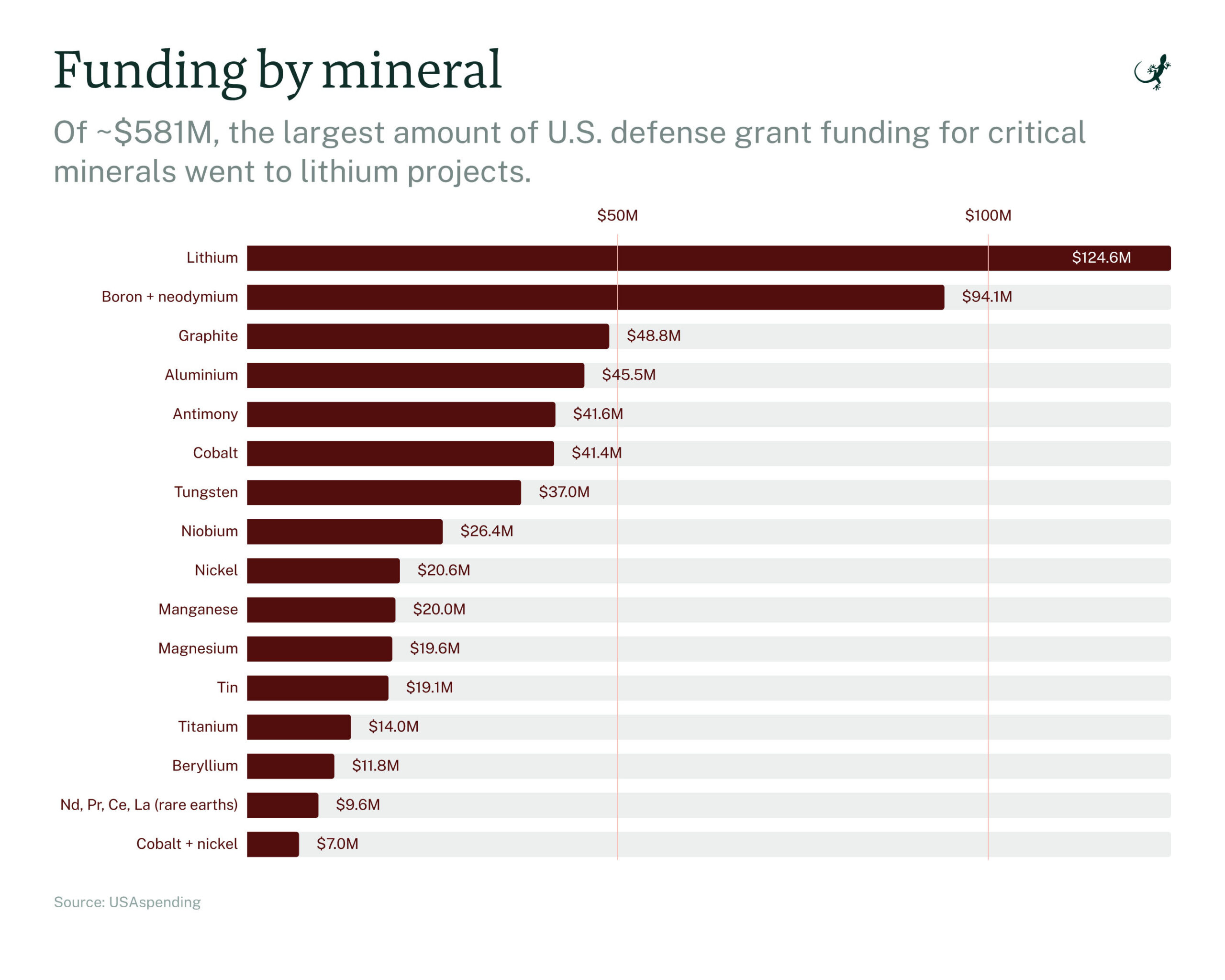
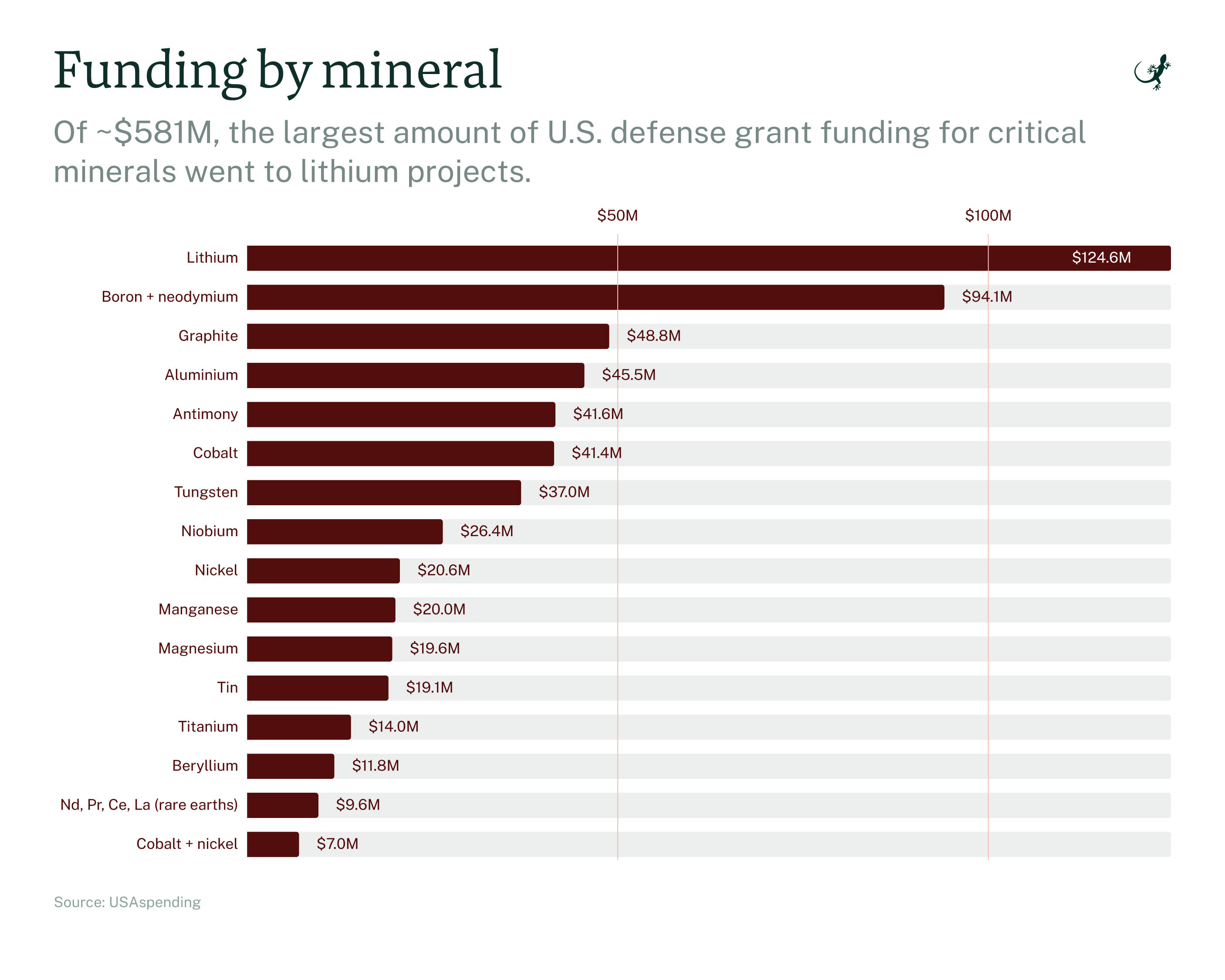
It poured the most funding into lithium projects ($124.6 million), followed by neodymium and boron projects ($94 million), graphite ($48.8 million) and aluminum ($45.4 million).
Lithium batteries are required for almost every weapon system used by the Pentagon, particularly for portable equipment, as it provides more energy with less weight. Neodymium and boron are used in magnets which are important for missiles, smart bombs, unmanned aerial vehicles and fighter jets. Graphite and aluminum are critical for building lighter, stronger, and more technologically advanced military applications.
Indigenous peoples and local communities said the government has implemented special permitting measures to shorten the authorization process for some of these projects in their territories or near their homes. Iñupiat communities affected by the Graphite Creek Project in Western Alaska, for instance, said they have received no information about the project from the company and they have not been consulted. Meanwhile, Graphite One, the company that owns the open-pit graphite mine, said it has had multiple meetings with local stakeholders to share information.
Community members said they are worried that accelerated permitting processes, without proper consultation, will lead to the destruction of critical habitats for animals they depend on for subsistence, as well as destroy sacred sites and other culturally significant areas for communities.
The Pentagon press office did not reply to a request for comment.
Out of the 27 funding grants analyzed by Mongabay, 74 percent of funding was allocated for projects based within the U.S. The Trump administration has been vocal about its wish to reduce dependence on critical mineral imports, and has issued an executive order to prioritize, expedite and advance domestic projects.
“Our national and economic security are now acutely threatened by our reliance upon hostile foreign powers’ mineral production,” the executive order states. “It is imperative for our national security that the United States take immediate action to facilitate domestic mineral production to the maximum possible extent.”
In 2015,Congress established FAST-41, a federal program to improve transparency, coordination and speed of environmental review and authorization process for large infrastructure projects. While the program states it does not change any regulatory requirement and public consultation, it also highlights that, in some cases, projects are approved up to 18 months sooner than projects not included in the portfolio.
A 2025 White House statement said the administration plans to consider more projects for FAST-41. The portfolio currently contains 18 mining projects. Several of these projects receive funding from the Pentagon or other defense-adjacent agencies. One such project is Graphite Creek. The Defense Department invested $37.3 million in the project in 2023 and received non-binding letters of interest from the Export-Import Bank of the United States, the country’s official credit export agency, for up to $2.07 billion.
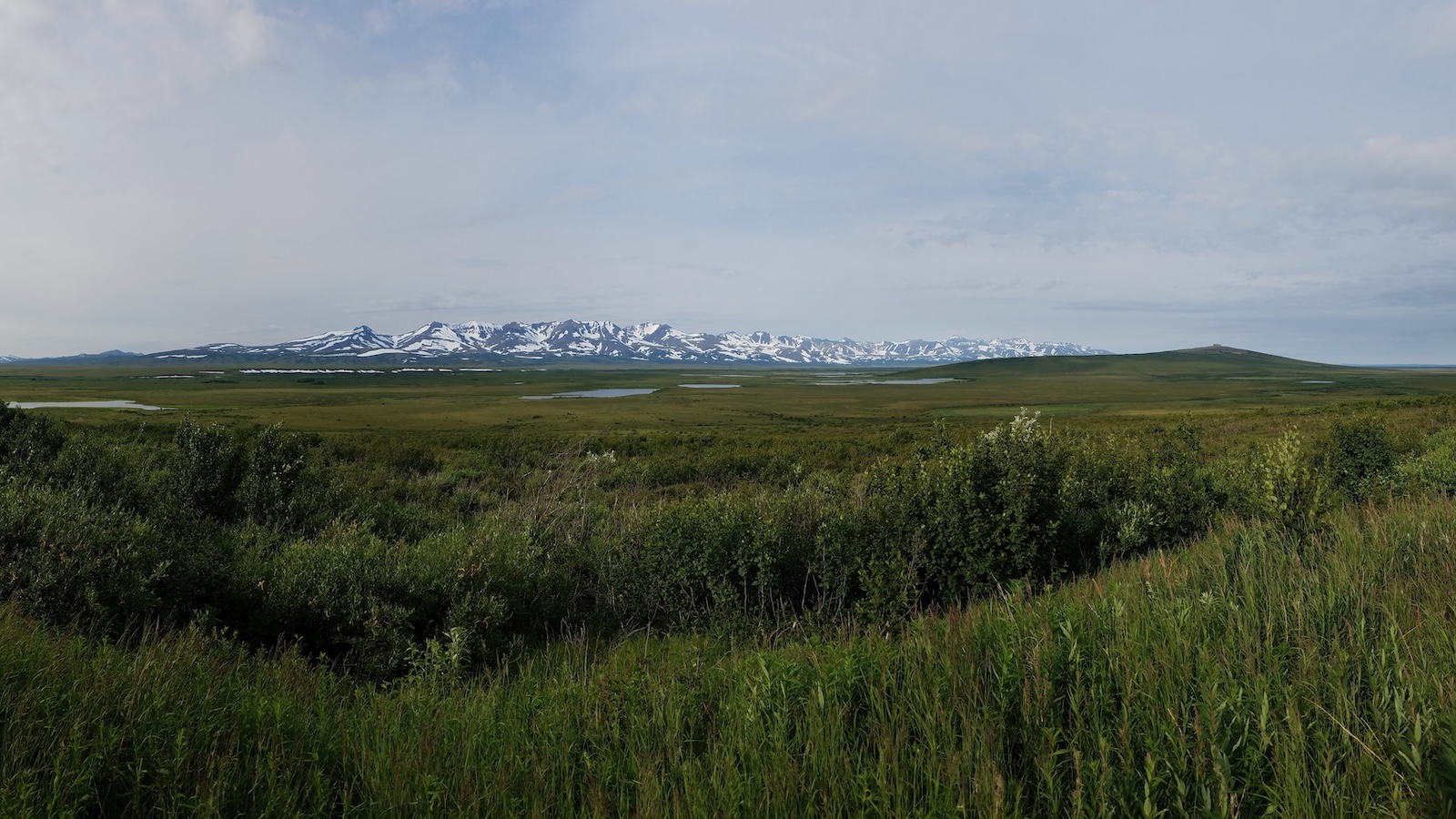
Adelaine Ahmasuk, a member of the affected Siqnasuagmuit community in Western Alaska, said that Graphite One never consulted her community about the project, which will impact hunting and fishing areas, as well as sites across the Kigluaik Mountains, which they consider sacred.
“We rely on money to get by, but most of our meat, most of the food, most of the berries that we eat, is what we harvest from the land,” she said. “If this mine were to happen, and if it were to drive animal populations down, to drive the moose away, we would have nothing left to sustain us, because we really rely heavily on being able to hunt and put away wild game, berries and greens.”
Ahmasuk said many community members, especially those in remote areas, have limited knowledge about what the project will entail, as the company has not approached them. Many don’t have access to tools like computers and environmental alert systems, which adds additional challenges, especially given the expedited approval processing time of its FAST-41 status.
“We, our community and our region, need more time to be prepared,” she explained. “People don’t even understand the impacts of hard rock mining. The [community] don’t understand how big a scale this is proposed to be. It’s supposed to be the largest domestic production of graphite in the U.S. This FAST-41 does not work [for us]. Consultation and consent are already being neglected.”
The company has not yet begun mining, but Ahmasuk says the project has already caused some problems.
“Right where the graphite is, there’s an ancient mound of rocks,” Ahmasuk explained. “Those are where Eagle Woman fell from the sky and landed on our mountains. We created these rock mounds to honor her. We also have rock mounds that are like little checkpoints for when we journey through the mountains. Graphite One put a helicopter pad directly on top of one of them.”
Lucille Carter, the vice president of community relations at Graphite One, said in an email that the project will provide a domestic supply of high-grade flake graphite, which is essential for many defense applications, as well as large-scale energy storage and electric vehicles.
Carter said that although formal government-to-government consultation is the responsibility of permitting agencies, since 2014, the company has held more than 75 meetings with local stakeholders to share information, seek feedback and improve the project based on local knowledge wherever possible.
“Graphite One cares deeply about being good neighbors to the communities near our project and sharing the benefits it can provide with local residents,” she said in the email. “We understand and respect the fact that there will always be individuals who have concerns about our work, but we do everything we can to involve those individuals in our process and incorporate their feedback into our work.”
Zeng Hui/Xinhua via Getty Images
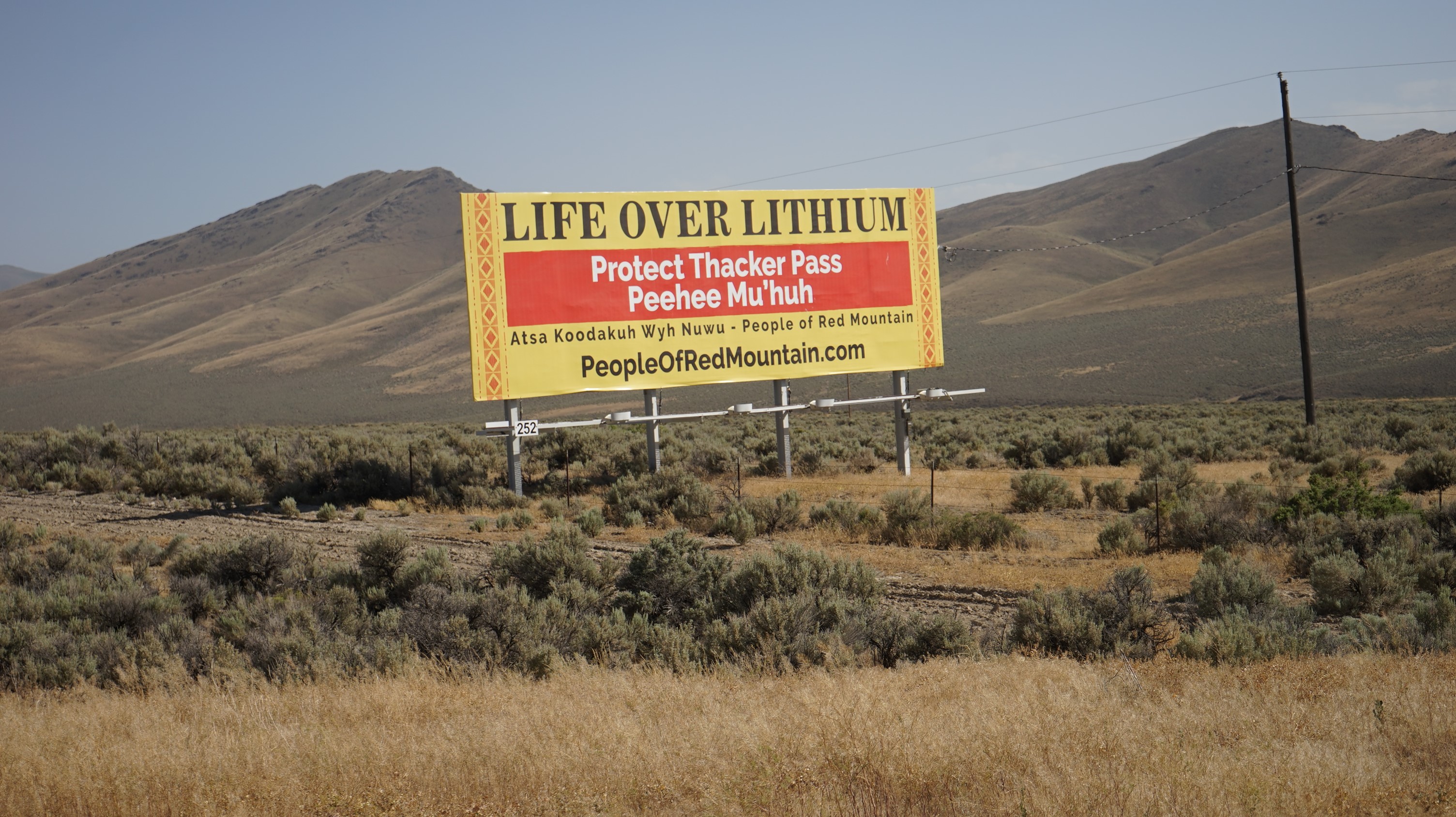
In Nevada, Indigenous nations and human rights organizations have raised concerns about the Thacker Pass lithium mine on ancestral lands, owned by Lithium Nevada LLC, a subsidiary of Lithium Americas Corp. The Pentagon provided the company with a $11.8–million grant in 2024.
People of Red Mountain, a committee led by knowledge keepers and descendants of Fort McDermitt Paiute, Shoshone and Bannock tribes, said in an email that they feel ill-informed about the process and are concerned about the environmental and cultural impacts, such as ecological damage that can affect how they interact with the land, practice hunting and gathering, as well as teach traditions and practice their religion.
“The state-backing of lithium mining is a serious concern as it allows permitting processes easier and more extraction-friendly,” a spokesperson for the group said in an email. “We hope our community concerns are taken seriously and are not just a box to check-off. We are concerned easy permitting will make the McDermitt Caldera, our ancestral homelands, a mining district and the State will have no intention to restore the ecosystem.”
Lithium Nevada LLC did not respond to requests for comment.
In recent years, several governments around the world have been pushing for a new agenda of military rearmament and a boost in defense industries, including Germany and France. Lorah Steichen, a researcher at the Transition Security Project, a research center that focuses on the global strategies of the U.S. and U.K. militaries, said that this has been especially true in the U.S. under the Trump administration.
Steichen pointed to a series of strategies the government has pursued to tighten its grip over mineral supply chains. It includes the use of the Defense Production Act, a law that grants the president powers to expand and accelerate the supply of minerals and services for defense purposes, as well as industrial policy strategies, such as price floors for some minerals, stockpiling and increased spending on mineral projects.
The federal government has invested in several mineral projects outside the U.S., although this only represented 26 percent of the grants Mongabay identified. All of these projects are in Canada.
Experts in sustainable development, international law, and mining and energy transitions that Mongabay spoke to pointed out that the push to increase military budgets and rearmament is a response to increasing geopolitical pressure, from Russia’s invasion of Ukraine to the Iran war.
“War unfortunately has been one of the driving forces of this race for more minerals,” said Edson Krenak, of the Indigenous Krenak people in southeastern Brazil.
Krenak says that his community has seen the harm caused by iron mining, and now nickel and other minerals are causing the same devastation. “Rivers have been contaminated,” Krenak said. “Rivers have been depleted completely from fish. We cannot fish, we cannot take baths, we cannot wash ourselves there anymore.”
Phil Johnstone, a research fellow at the University of Sussex in the U.K., as well as the University of Tartu in Estonia and Utrecht University in the Netherlands, said that, as a result of this pressure, there could be a transformation of mineral supply chains, with an increase in demand for minerals that are critical for defense industries, but also changes in the measures and governance mechanisms used to acquire those minerals.
This could lead to a decrease in the availability of minerals needed for the energy transition, he said.
“Military demand is more likely, in situations of crisis, to have a priority,” said Anabel Marin, a research fellow at the Institute of Development Studies in the U.K. and a researcher at the National Council for Scientific and Technical Research in Argentina, echoing Johnstone’s statements. “The demand that responds to military priorities also reshapes trade patterns, relationships between countries, and it is shaping the way in which minerals are being extracted, the logic under which minerals are extracted.”
Experts also pointed out the similarity between the current race to secure access to minerals and other races to secure access to natural resources considered critical throughout recent history. An example is the rubber rush driven in part by the demand for rubber during World War I, and again during World War II, for vehicles and tanks.
The consequences of this rush were experienced by Amazonian communities, including in Brazil, Bolivia, Peru and Colombia. The rubber barons subjected Indigenous communities to debt slavery, accelerated the decline of Indigenous peoples and, in extreme cases, exterminated entire villages.
Luis Eslava, a professor of international law at La Trobe University’s Law School, Australia, said, “It is really important to remember that there has not been a moment where law has not been part of the equation, even when we think about earlier forms of exploitation during the heyday of the colonial period.”
“There was always a mechanism, legal mechanisms put in place in order for them to establish agreement on the ground, sign concessions, extend the jurisdiction of the British empire into new lands,” he said. “This is important because it reminds us that part of the problem has always been how law has been used in order to lubricate this process of extraction.”
Indigenous leaders from Nevada to Brazil say this latest push to mine minerals for military uses is the latest step in a long history of exploitation. “It is a legacy that we have to deal with,” Krenak said. “And when we see on the news those companies growing, investing, getting support from the government, as nothing had ever happened to them or done by them, it makes us very sad.”
Grist reporter Joseph Lee contributed reporting to this story.
This story was originally published by Grist with the headline The US military is spending big on critical minerals on Jun 18, 2026.