

Europe has spent several weeks enduring blistering heat. The heatwave the continent experienced last month closed schools, disrupted power supplies, and has been linked to thousands of deaths. France, Germany, and Denmark all saw their highest temperature ever, according to the World Meteorological Organization. Now, new data shows that western Europe set another record: its hottest June ever.
The readings, from the European Union’s Copernicus Earth observation program, showed that western Europe averaged 20.74 degrees Celsius, or a little over 69 degrees Fahrenheit, across the entire month — night and day. That squeaks past the previous mark set during June of 2025, and is more than 3 degrees Celsius above the average for the month. Ocean temperatures were also the hottest ever recorded. Globally, June was only .01 degrees Celsius off the all-time high.
“These records reflect a climate system continuing to accumulate heat,” Samantha Burgess, deputy director of the Copernicus Climate Change Service, said in a statement. “The result is increasingly intense heatwaves, a persistently warm ocean, and growing risks for people, ecosystems, and infrastructure across Europe and beyond.”

The late-June heatwave followed a similar spike in May, and preceded still more high temperatures in July. These extreme conditions would have been virtually impossible 50 years ago, the World Weather Attribution initiative noted last month. Climate change, it said, is driving a new, dangerous norm that’s wreaking havoc on European systems that weren’t built for these risks.
“Many people still live, work, and study in places that are not designed for the temperatures we are now experiencing,” Carolina Pereira Marghidan, with the Red Cross Red Crescent Climate Centre, said in a statement. “We need greater investment in heat-resilient homes, cities, and infrastructure to keep people safe.”
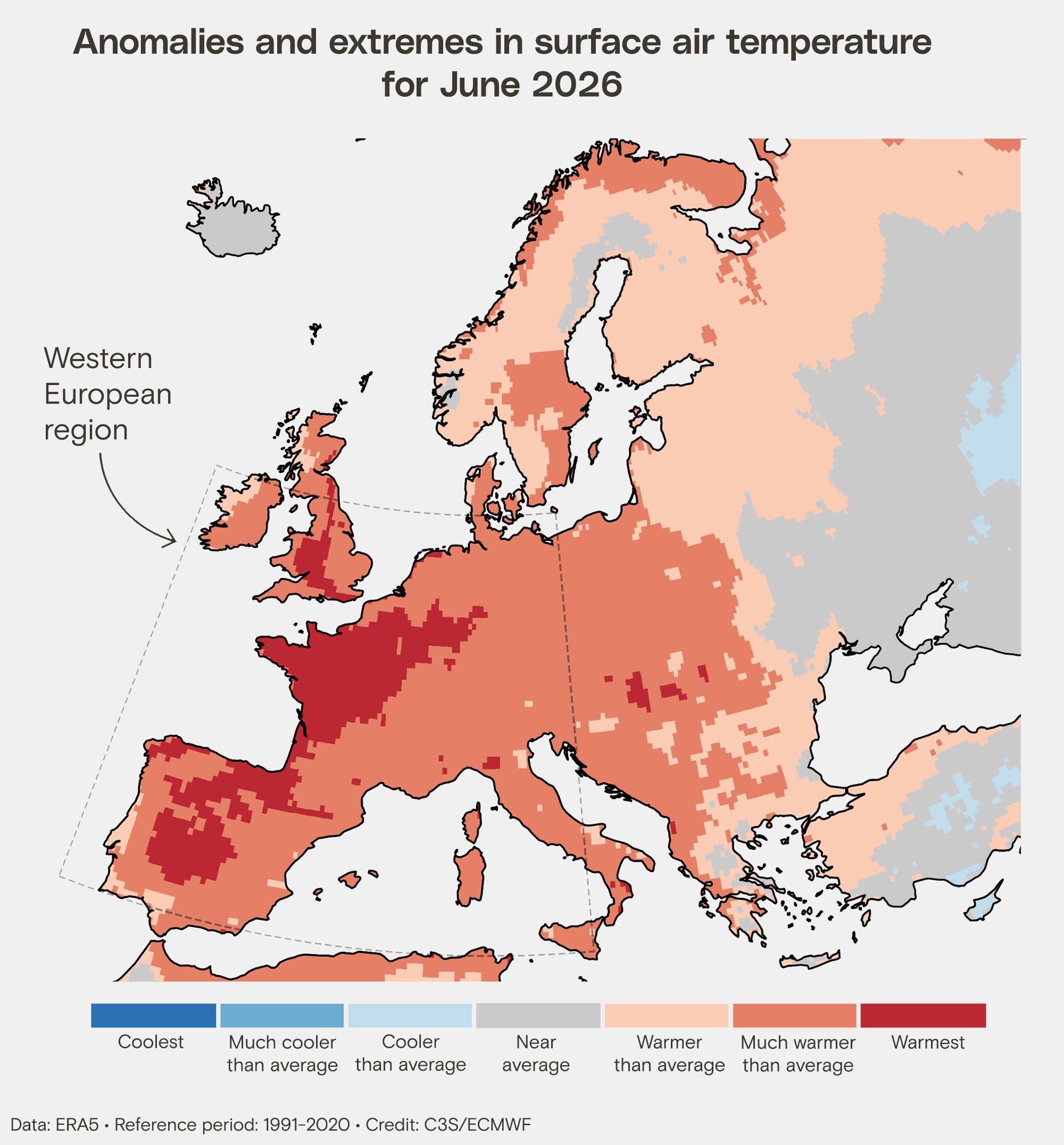
Recent extremes are reminiscent of Europe’s sweltering summer of 2003. Since then, World Weather Attribution scientists say climate change has made daytime heat of the kind Europe is experiencing 10 times more likely and overnight extremes 100 times more likely. Going into the morning of June 28, a weather station in East Saxony, Germany, recorded a minimum temperature of 29.4 degrees Celsius, or nearly 85 Fahrenheit. The country’s meteorological agency, Deutscher Wetterdienst, called the reading historic.
Experts say elevated overnight minimums are especially concerning for human health. “When we have these high nighttime temperatures, the body isn’t able to recover sufficiently,” said Kurt Shickman, who works on heat issues at the World Resources Institute. “They’re going into the next hot day with a couple strikes against you from a health perspective.”
The heat is also further fueling wildfire risks in parts of Europe that are already dry. Fires in Spain and southern France have caused thousands to flee, thwarted Tour de France spectators, and killed at least one firefighter. Such conditions are expected to continue, as is the general trend toward a warmer planet.
Extreme weather can sometimes prompt policymakers to take action. After the 2003 heatwaves, European governments developed early warning systems and other adaptation measures that research shows would have reduced deaths by as much as 75 percent. Shickman also points to apps like Extrema, which help people map the thermally safest route when they’re traveling. But he says there’s a lot more that could still be done — from increasing access to affordable air conditioning to installing more resilient infrastructure, such as reflective roofs and cooler walls — in the face of a warming future.
Extreme heat is “something that we’re seeing more and more of,” said Shickman. But he’s also optimistic that events like this can also be a catalyst for change. “These types of iconic moments can be galvanizing for years and years to come.”
This story was originally published by Grist with the headline Western Europe just set the record for its hottest June ever on Jul 8, 2026.