
Scientists make breakthrough in solving mystery of volcanic lightning
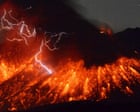
Research shows fine carbon coating on silica in updraught causes electrical charge – and spectacular display
Researchers are a step closer to understanding volcanic lightning, one of the most spectacular atmospheric phenomena, which can be seen playing among the clouds of smoke and ash during an eruption. The intensity is extreme: the Hunga Tonga-Hunga Ha‘apai eruption, in the Tongan archipelago in 2022, produced more than 2,600 lightning flashes a minute stretching up to 19 miles (31km) above sea level.
We know that storm clouds become electrically charged as a result of collisions between ice crystals rising in updraughts and falling particles of graupel, or soft hail. The ice picks up positive charge and the hail negative. What has puzzled scientists is how a volcanic plume, which is dry and consists of ash and rock fragments, could pick up charge. Particles made from the same rocky material should not do that during collisions.